


PandaHomeMart
Danshen Root Slices (Dan Shen) – 250 g
Danshen Root Slices (Dan Shen) – 250 g
Couldn't load pickup availability
Danshen Root Slices (Dan Shen)™ — 250 g
Rust-red root edges. Visible natural grain. A distinctive traditional Chinese botanical root presented for careful preparation.
Discover Danshen Root Slices (Dan Shen / 丹参)—dried slices of Salvia miltiorrhiza root with distinctive reddish-brown outer edges, warm tan centers and visible natural root grain.
Unlike sweet dried fruits, floral ingredients or familiar culinary spices, Danshen offers an unmistakably root-forward character:
Earthy · Root-Like · Naturally Bitter · Botanical
With 250 g / 8.82 oz of dried Danshen Root Slices, this substantial botanical format is designed for shoppers already familiar with Dan Shen or intentionally exploring traditional Chinese root ingredients.
The sliced presentation keeps the natural root structure visible while making individual pieces easy to identify and handle according to the product-specific preparation directions.
Why You’ll Appreciate It
-
250 g / 8.82 oz — a substantial botanical-root format for repeated preparation
-
Authentic botanical identity — Salvia miltiorrhiza root
-
Visible sliced-root structure — natural cross-sections rather than powder
-
Distinctive rust-red appearance — reddish-brown outer edges with lighter tan centers
-
Natural root grain — visible radial patterns reveal the ingredient's natural structure
-
Root-forward character — earthy, botanical and naturally bitter
-
Easy to identify — visually distinct from paler roots such as Astragalus and many Ginseng products
-
Traditional botanical pantry ingredient — suited to shoppers intentionally exploring Chinese botanical roots
Product at a Glance
-
Product: Danshen Root Slices (Dan Shen)™
-
Chinese name: 丹参
-
Pinyin: Dan Shen
-
Botanical name: Salvia miltiorrhiza
-
Also known as: Danshen · Chinese Red Sage Root · Red Sage Root
-
Form: Dried sliced root
-
Net weight: 250 g / 8.82 oz
-
Appearance: Rust-red to reddish-brown outer edges with tan to warm golden centers
-
Flavour: Earthy · Root-like · Naturally bitter · Botanical
-
Category: Traditional Chinese botanical root
-
Preparation: Follow the serving amount, preparation method and usage directions provided on the product label
-
Tea leaves: Contains no Camellia sinensis tea leaves
-
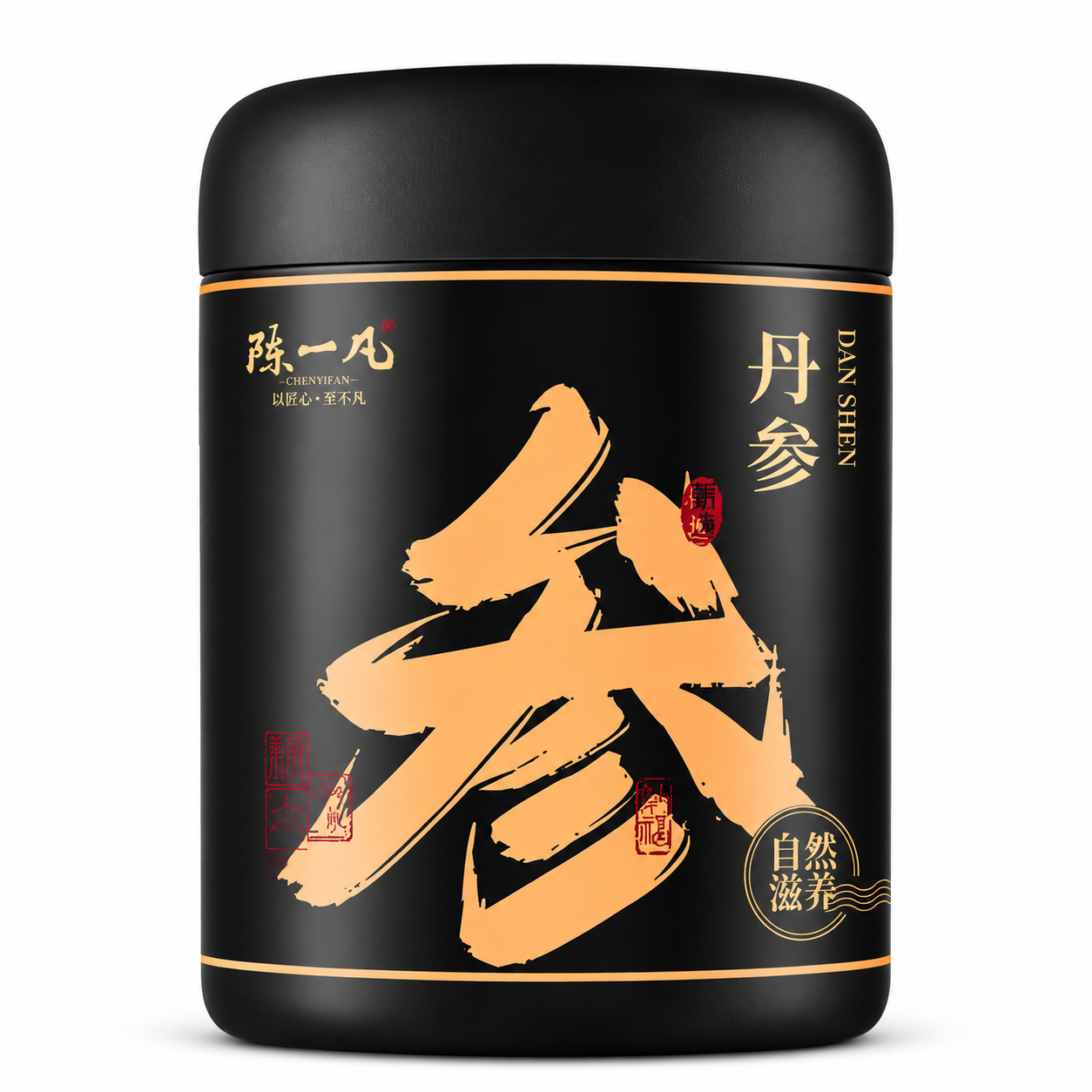
Packaging: Black-and-gold storage container
-
Best for: Traditional botanical preparations · Botanical-root discovery
-
Ideal for: Shoppers familiar with Danshen · People intentionally exploring traditional Chinese botanical roots
-
Important distinction: Danshen is not Ginseng, American Ginseng, Astragalus or ordinary culinary Sage
Natural root slices may vary slightly in diameter, thickness, shape, colour and visible grain.
What Is Danshen / Dan Shen / 丹参?
Danshen, written 丹参 and romanized as Dan Shen, is the dried root of Salvia miltiorrhiza.
It is a traditional Chinese botanical ingredient recognizable by its reddish-brown root exterior, lighter-coloured interior and visible natural root structure.
The clearest product identity is:
Danshen Root Slices · Dan Shen · 丹参 · Salvia miltiorrhiza
Botanical identity is particularly important for this ingredient because many traditional roots are sold in sliced form and can appear superficially similar.
Using Salvia miltiorrhiza makes it clear that Danshen is a distinct botanical root rather than a type of Ginseng or Astragalus.
What Is Salvia miltiorrhiza?
Salvia miltiorrhiza is the botanical identity of Danshen / Dan Shen / 丹参.
On this product page:
Danshen · Dan Shen · 丹参 · Salvia miltiorrhiza
all refer to the same botanical-root ingredient.
The botanical name is especially useful when comparing traditional roots because it clearly distinguishes Danshen from the Panax group associated with Ginseng.
Appearance & Natural Root Character
Danshen is visually distinctive among traditional botanical roots.
Typical characteristics include:
-
Rust-red to reddish-brown outer edges
-
Tan to warm golden centers
-
Visible radial root grain
-
Naturally textured outer bark
-
Round or irregular cross-sections
-
Natural variation in diameter
-
Variation in slice thickness
-
Slight differences in colour between pieces
These variations are expected in a natural botanical-root product.
The contrast between the reddish exterior and lighter interior is one of the easiest visual ways to recognize sliced Danshen.
Taste & Character
Danshen is not a sweet botanical ingredient.
Flavour Character:
Earthy · Root-like · Naturally bitter · Botanical
Its sensory profile is much closer to traditional dried roots than to fruit or floral infusions.
Compared with other ingredients:
Goji → Fruity · Gently sweet
Longan → Mellow · Naturally sweet
Rose → Floral · Aromatic
Ginger → Warm · Spicy · Aromatic
Danshen → Earthy · Root-like · Naturally bitter
For shoppers new to traditional Chinese botanicals, this expectation matters.
Danshen is selected for its distinctive traditional root identity, not for a sweet or dessert-like flavour.
Danshen vs. Ginseng
Danshen and Ginseng are completely different botanical ingredients.
Danshen
-
Chinese name: 丹参
-
Botanical identity: Salvia miltiorrhiza
-
Botanical root
-
Reddish-brown exterior with lighter center
-
Earthy and naturally bitter
Ginseng
-
Chinese name commonly associated with 人参
-
Botanical identity: Panax species
-
Ginseng root
-
Generally paler root appearance
-
Distinct Ginseng identity
The key point is simple:
Danshen is not Ginseng.
The botanical name Salvia miltiorrhiza provides the clearest distinction.
Danshen vs. American Ginseng
Danshen should also not be confused with American Ginseng / 西洋参.
Danshen
-
丹参
-
Salvia miltiorrhiza
-
Rust-red to reddish-brown exterior
-
Earthy and naturally bitter botanical root
American Ginseng
-
西洋参
-
Panax quinquefolius
-
Generally paler root slices
-
Ginseng-root identity
Both may appear in sliced-root form, but they are botanically different ingredients.
Choose products according to their exact name, botanical identity and packaging rather than assuming sliced traditional roots are interchangeable.
Danshen vs. Astragalus
Danshen and Astragalus are also different traditional botanical roots.
Danshen / Dan Shen
-
Chinese name: 丹参
-
Reddish-brown exterior with lighter center
-
Earthy and naturally bitter
-
Distinct Salvia miltiorrhiza identity
Astragalus / Huang Qi
-
Chinese name: 黄芪
-
Typically pale yellow-beige slices
-
Milder root character
-
Different botanical ingredient
Their appearance and flavour direction make them relatively easy to distinguish when displayed as sliced roots.
They should not automatically be substituted for one another.
Is Danshen Culinary Sage?
No.
Although Chinese Red Sage Root and Red Sage Root are English names sometimes associated with Danshen, this product is:
Salvia miltiorrhiza root
It should not be confused with ordinary culinary Sage used as an herb in cooking.
For the clearest product identification, use:
Danshen / Dan Shen / 丹参 / Salvia miltiorrhiza
rather than relying only on the word “Sage.”
Why Choose Danshen Root Slices?
This product is presented as visible dried root slices rather than whole roots or powder.
The sliced format allows you to clearly see:
-
Reddish-brown outer edges
-
Lighter tan centers
-
Natural root grain
-
Individual botanical cross-sections
It also makes individual pieces easy to identify and handle according to the product-specific preparation directions.
The amount used should still be determined by the product label rather than estimated only from the number or size of slices.
How to Prepare Danshen Root Slices
Danshen is a traditional botanical ingredient, and preparation requirements may depend on the specific product.
01 · Check the Label
Read the serving and preparation directions provided on the product packaging.
02 · Measure as Directed
Use only the amount specified by the product directions.
03 · Prepare
Use clean preparation equipment and follow the specified method.
04 · Follow Product-Specific Parameters
Use the water amount, preparation duration and other instructions provided for this specific product.
05 · Do Not Assume Tea Parameters
Do not automatically apply ordinary loose-leaf tea temperatures, ratios or steeping times.
06 · Follow All Product Guidance
Follow all preparation, serving, warning and usage information supplied with the product.
This is more appropriate than assigning one universal preparation recipe to a traditional botanical root.
Is Danshen a Tea?
Not in the conventional sense.
Traditional:
Green Tea · White Tea · Black Tea · Oolong · Pu-erh
come from Camellia sinensis.
Danshen is a:
Botanical Root
Consumers may commonly search for:
Danshen Tea · Dan Shen Tea
but the ingredient itself is not conventional tea.
Depending on the product-specific preparation method, a water-based preparation is more accurately described as a botanical preparation or root infusion.
Can Danshen Be Brewed Like Loose-Leaf Tea?
Do not automatically use conventional loose-leaf tea parameters.
Danshen is a botanical root rather than tea leaves.
Follow the product-specific preparation method, serving amount, water quantity and duration supplied on the label.
How Much Danshen Should I Use?
Use the serving amount specified on the product label.
This page intentionally does not assign an independent universal serving quantity.
Different products and preparation methods may have different instructions, so the packaging should take priority.
A Distinctive Addition to the Botanical Root Pantry
Danshen fits naturally alongside:
Astragalus · American Ginseng · Red Ginseng · Angelica Root · Ophiopogon · Polygonatum · Dandelion Root · Ginger · Other Traditional Botanical Roots
Within a broader root pantry:
Astragalus → Pale yellow · Mild root character
American Ginseng → Pale root · Ginseng identity
Ginger → Warm · Spicy · Aromatic
Angelica Root → Distinct traditional root identity
Danshen → Rust-red · Earthy · Naturally bitter · Salvia miltiorrhiza
For PandaHomeMart, Danshen fits most naturally within:
Healing Botanicals → Botanical Roots
rather than Classic Tea, Sun-Ripened Fruits or ordinary culinary ingredients.
Important Product Guidance
Danshen is a traditional botanical ingredient, not an ordinary dried fruit or everyday beverage ingredient.
For this product:
-
Follow the product label for preparation
-
Follow the serving amount stated on the packaging
-
Follow all product-specific usage directions
-
Follow all warnings printed on the packaging
-
Do not automatically apply ordinary tea-brewing parameters
-
Do not assume Danshen is interchangeable with Ginseng, American Ginseng, Astragalus or other traditional roots
-
If the product label identifies specific restrictions or advises professional guidance, follow those directions
This page intentionally does not assign medical uses, health outcomes or universal serving instructions beyond the information provided for the product.
Storage & Care
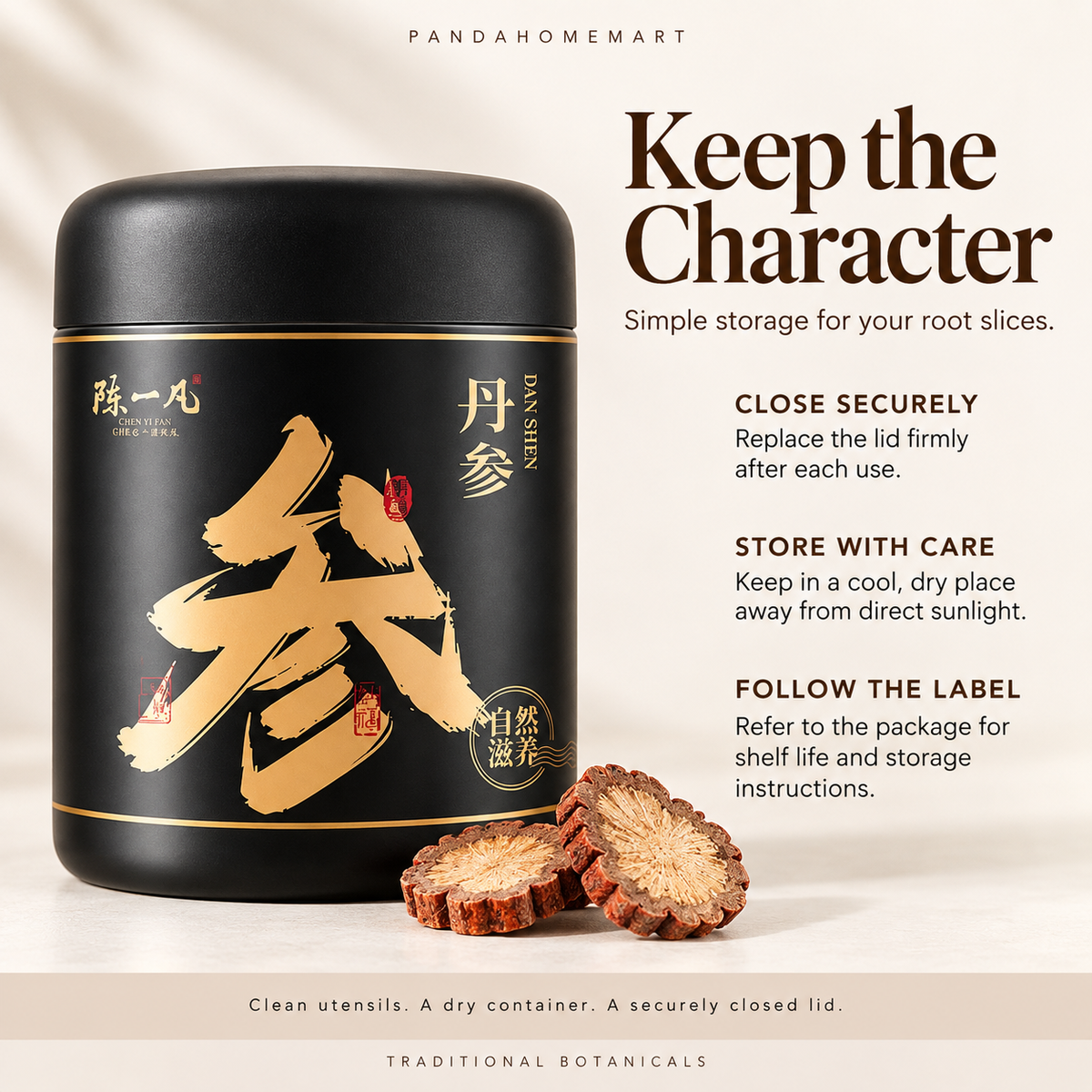
Keep the container securely closed in a cool, dry place away from moisture, excessive humidity, direct sunlight, heat and strong odours.
Use clean, dry utensils when handling the root slices.
Refer to the product label for the best-before date and all additional preparation, usage and storage information.
Frequently Asked Questions
What is Danshen?
Danshen / Dan Shen / 丹参 is the dried root of Salvia miltiorrhiza, a traditional Chinese botanical ingredient.
What does Dan Shen mean?
Dan Shen / 丹参 is the Chinese name used for Salvia miltiorrhiza root.
For product identification:
Dan Shen = Danshen = 丹参 = Salvia miltiorrhiza
How much is included?
This package contains 250 g / 8.82 oz of dried Danshen Root Slices.
Is this whole Danshen Root?
No. The product is presented as dried root slices, rather than whole roots or powder.
What is the botanical name of Danshen?
The botanical name is Salvia miltiorrhiza.
What is another English name for Danshen?
Danshen is sometimes called Chinese Red Sage Root or Red Sage Root.
Because these names can be confused with culinary Sage, Salvia miltiorrhiza is the clearest botanical identifier.
Is Danshen the same as Chinese Red Sage Root?
“Chinese Red Sage Root” is an English name sometimes used for Danshen.
The product on this page is specifically Salvia miltiorrhiza root.
Is Danshen culinary Sage?
No.
Danshen is Salvia miltiorrhiza root and should not be confused with ordinary culinary Sage used as a cooking herb.
Is Danshen the same as Ginseng?
No.
Danshen is Salvia miltiorrhiza.
Ginseng belongs to the Panax group.
They are botanically different plants.
Is Danshen the same as American Ginseng?
No.
Danshen is Salvia miltiorrhiza, while American Ginseng is Panax quinquefolius.
They are different botanical roots.
Is Danshen the same as Astragalus?
No.
Danshen / 丹参 and Astragalus / Huang Qi / 黄芪 are different botanical roots.
Danshen typically has a reddish-brown exterior and naturally bitter root character, while Astragalus is generally paler and milder.
What does Danshen look like?
Danshen Root Slices typically show rust-red to reddish-brown outer edges, tan to warm golden centers and visible natural root grain.
Natural variation between slices is expected.
What does Danshen taste like?
It generally has an:
Earthy · Root-Like · Naturally Bitter · Botanical
character.
It should not be expected to taste sweet or fruit-forward.
Is Danshen sweet?
No.
Danshen is better characterized as earthy, root-like and naturally bitter rather than sweet.
Is Danshen a tea?
No.
Danshen is a botanical root rather than leaves from Camellia sinensis.
“Danshen Tea” is a common search phrase, but a botanical root preparation or root infusion is the more accurate description.
Can I brew Danshen like loose-leaf tea?
Do not automatically use conventional loose-leaf tea parameters.
Follow the preparation method, serving amount, water quantity and duration specified on the product label.
How do I prepare Danshen Root Slices?
Follow the serving amount and preparation directions supplied with the product.
This page does not assign one universal steeping or preparation method.
How much Danshen should I use?
Use the amount specified on the product label.
Do not substitute an independently estimated serving quantity for the product-specific directions.
Are Danshen Root Slices the same as Danshen Powder?
No.
This product is presented as visible dried root slices, while Danshen Powder is a finely ground format.
The two formats may behave differently during preparation.
Why choose Danshen Root Slices instead of powder?
The sliced format keeps the natural root structure visible.
You can clearly see the characteristic reddish-brown outer edges, lighter tan centers and natural root grain.
Can Danshen be substituted for Ginseng?
No.
Danshen and Ginseng are botanically different roots and should not automatically be substituted for one another.
Can Danshen be substituted for American Ginseng?
No.
Danshen is Salvia miltiorrhiza, while American Ginseng is Panax quinquefolius.
Use the exact ingredient required by the preparation being followed.
Can Danshen be substituted for Astragalus?
Do not assume so.
Danshen and Astragalus are different botanical roots with different identities and sensory characteristics.
Is Danshen suitable for beginners?
Danshen is best suited to shoppers who intentionally want to explore traditional Chinese botanical roots or who already know the ingredient.
Its earthy, root-like and naturally bitter character is considerably different from sweet dried fruits, floral ingredients and familiar tea leaves.
First-time users should follow the product-specific preparation directions carefully.
Who are Danshen Root Slices best for?
They are especially suited to people already familiar with Danshen, shoppers exploring traditional Chinese botanical roots, people building a botanical-root pantry and customers specifically searching for Dan Shen / 丹参 or Salvia miltiorrhiza.
Discover a Distinctive Traditional Root
Rust-red outer edges. Warm tan centers. Visible natural root grain. An earthy, naturally bitter botanical identity.
Explore Danshen as the traditional botanical root it is—not as Ginseng, conventional tea or culinary Sage.
Its sliced format keeps the natural root structure visible and provides a convenient way to handle the ingredient according to the preparation directions supplied with the product.
Choose Danshen Root Slices (Dan Shen)™ — 250 g and add to cart.
Bring Eastern Living Home.
Share




Complete Your Tea Ritual


