


PandaHomeMart
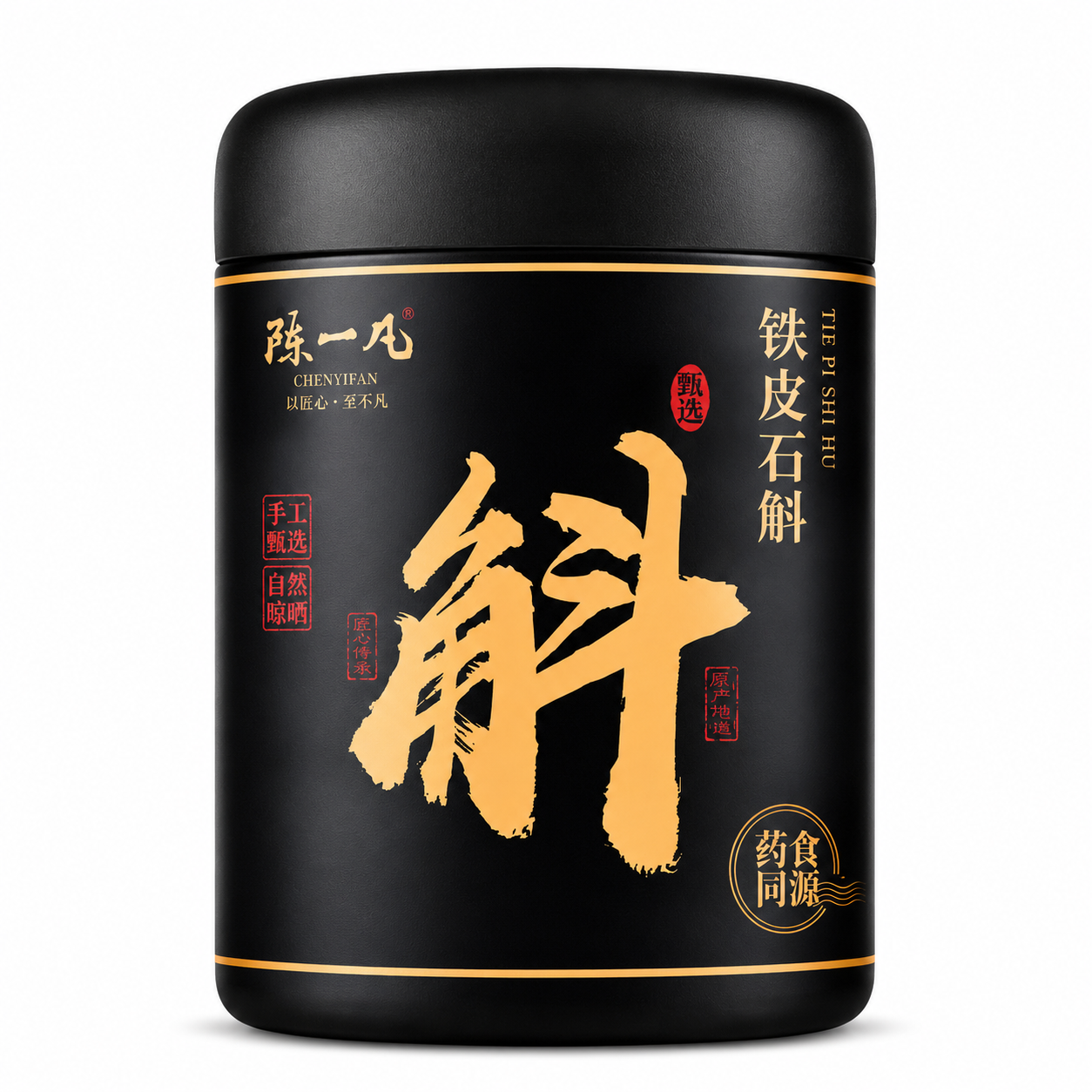
Dendrobium Stem (Tie Pi Shi Hu) – 50 g
Dendrobium Stem (Tie Pi Shi Hu) – 50 g
Couldn't load pickup availability
Dendrobium Stem (Tie Pi Shi Hu) – 50 g
Distinctive segmented stems. Mild botanical character. A traditional Chinese ingredient with a clear stem-based identity for carefully prepared botanical rituals.
Discover Dendrobium Stem (Tie Pi Shi Hu / 铁皮石斛), dried Dendrobium stems presented in a recognizable botanical format with visible segmentation, naturally fibrous surfaces and pale green-to-yellow-green coloring.
With a net weight of 50 g / 1.76 oz, this compact format offers a practical introduction to one of the more visually distinctive traditional Chinese botanical ingredients.
Its defining sensory profile is:
Mild · Clean · Vegetal · Delicate · Botanical
Tie Pi Shi Hu looks and feels very different from sliced roots, leaves, fruits or conventional tea.
Its strongest identifying features are:
Slender Stem Form · Visible Segmentation · Fibrous Texture · Pale Green-to-Yellow-Green Tones
For the clearest product identity:
Tie Pi Shi Hu · 铁皮石斛 · Dendrobium Stem
Tie Pi Shi Hu is commonly associated with Dendrobium officinale, but exact species identification for this specific commercial product should follow supplier documentation and product labeling.
It is also important to distinguish Tie Pi Shi Hu from the broader term:
Shi Hu / 石斛
For this product, Tie Pi Shi Hu / 铁皮石斛 should remain the primary identity.
Distinctive stems. Gentle character. A quiet traditional botanical ritual.
Product at a Glance
-
Product: Dendrobium Stem
-
Primary identity: Tie Pi Shi Hu
-
Chinese name: 铁皮石斛
-
Pinyin: Tie Pi Shi Hu
-
Also known as: Dried Dendrobium, Dendrobium Stem
-
Common botanical association: Dendrobium officinale
-
Plant part: Stem
-
Form: Dried stems / stem pieces
-
Net weight: 50 g / 1.76 oz
-
Appearance: Pale green to yellow-green segmented stems
-
Texture: Naturally fibrous and visibly jointed
-
Flavor profile: Mild, clean, vegetal, delicate and botanical
-
Category: Traditional Chinese Botanical Ingredient
-
Best for: Appropriate botanical preparations and traditional-inspired recipes
-
Preparation: Follow product-specific serving and preparation directions
-
Ideal for: Shoppers exploring identifiable traditional Chinese botanical ingredients
-
Format advantage: Visible dried stem material rather than powder
-
Important distinction: Tie Pi Shi Hu is a stem ingredient, not a root
-
Second distinction: Tie Pi Shi Hu is more specific than the broader term Shi Hu / 石斛
-
Tea classification: Not conventional tea from Camellia sinensis
-
Species note: Exact species identification should follow supplier documentation and product labeling
Why You'll Appreciate Tie Pi Shi Hu
Distinctive Segmented Stem Form
Tie Pi Shi Hu has one of the clearest visual identities in the botanical pantry.
Typical dried material may show:
-
Slender stem pieces
-
Visible segmentation
-
Clearly jointed sections
-
Fibrous outer texture
-
Pale green to yellow-green coloring
-
Slightly curled forms
-
Natural variation in thickness
-
Natural variation in length
This makes the ingredient easy to distinguish from:
Roots · Leaves · Fruits · Seeds · Grain Ingredients
Mild Botanical Character
Tie Pi Shi Hu offers a relatively gentle sensory profile.
Typical Flavor Profile
Mild · Clean · Vegetal · Delicate · Botanical
Compared with:
Ginger → Warm & pungent
Danshen → Earthy & bitter
Lotus Seed Hearts → Distinctly bitter
Tie Pi Shi Hu → Mild, clean & delicate
This softer character helps define its place within a broader traditional botanical collection.
Visible Whole Botanical Material
This product is presented as recognizable dried stem material rather than a finely ground format.
Shoppers can see:
-
Natural stem shape
-
Segmentation
-
Fibrous surfaces
-
Variation in color
-
Variation in thickness
This visible format keeps the ingredient identity clear.
Stem-Based Botanical Identity
One of the most important facts about Tie Pi Shi Hu is the plant part used.
This product is a:
Stem
not a:
Root
not a:
Leaf
not a:
Fruit
That distinction helps separate it clearly from American Ginseng, Mai Dong and Huang Jing.
Compact 50 g Botanical Exploration Size
With 50 g / 1.76 oz, this package provides a compact format for shoppers who want to explore Tie Pi Shi Hu without purchasing a very large quantity.
What Is Tie Pi Shi Hu / 铁皮石斛?
Tie Pi Shi Hu / 铁皮石斛 is a traditional Chinese botanical ingredient commonly associated with:
Dendrobium officinale
The product is derived from:
Dendrobium Stem Material
rather than root material.
The name may appear online as:
Tie Pi Shi Hu · 铁皮石斛 · Dendrobium Stem · Dendrobium officinale
For this product, the clearest naming structure is:
Dendrobium Stem (Tie Pi Shi Hu / 铁皮石斛)
This preserves both the English product form and the more specific traditional Chinese identity.
What Does Tie Pi Shi Hu Mean?
Tie Pi Shi Hu / 铁皮石斛 is the specific Chinese ingredient name used for this Dendrobium product.
For product identification:
Tie Pi Shi Hu / 铁皮石斛 → Dendrobium Stem
This page keeps the established Chinese name rather than forcing an overly literal English translation.
Is Tie Pi Shi Hu the Same as Shi Hu?
Not exactly.
Shi Hu / 石斛 is a broader traditional name associated with Dendrobium materials.
Tie Pi Shi Hu / 铁皮石斛 is a more specific product identity commonly associated with Dendrobium officinale.
For this page, the stronger product identity is:
Tie Pi Shi Hu / 铁皮石斛
rather than simply:
Shi Hu
This distinction is important for accurate product search and AI matching.
Is This Dendrobium officinale?
Tie Pi Shi Hu is commonly associated with:
Dendrobium officinale
However, exact species identification for this specific commercial product should follow:
Supplier Documentation + Product Labeling
This page therefore does not rely on the species name alone unless it is confirmed for the actual product.
What Does Dendrobium Look Like?
Typical dried Tie Pi Shi Hu may feature:
-
Slender stems
-
Segmented or jointed structure
-
Pale green coloring
-
Yellow-green tones
-
Naturally fibrous surfaces
-
Slightly curled forms
-
Irregular lengths
-
Natural variation in thickness
Variation is expected in a dried botanical stem product.
What Does Tie Pi Shi Hu Taste Like?
Tie Pi Shi Hu generally has a relatively gentle sensory profile.
Typical Sensory Character
Mild · Clean · Vegetal · Delicate · Botanical
It should not be expected to taste like:
-
Sweet dried fruit
-
Strongly floral tea
-
Spicy ginger
-
Bitter Danshen
-
Pungent roots
Its identity is quieter and more subtle.
Is Tie Pi Shi Hu Sweet?
This product is primarily characterized as:
Mild · Clean · Vegetal · Delicate
rather than as a strongly sweet ingredient.
Any natural sweetness should be expected to remain subtle and preparation-dependent.
How to Prepare Tie Pi Shi Hu
Tie Pi Shi Hu is a traditional botanical ingredient rather than conventional loose-leaf tea.
Follow the product-specific preparation directions.
01 · Check
Read the serving amount provided on the product packaging.
02 · Measure
Use only the directed quantity.
03 · Prepare
Rinse or otherwise prepare the stems if instructed.
04 · Add Water
Use fresh drinking water according to the product directions.
05 · Prepare as Directed
Follow the recommended preparation method and duration.
06 · Follow Product Guidance
Observe all serving, usage, warning and preparation information provided with the product.
Do not automatically apply conventional Green Tea, Black Tea or other loose-leaf tea parameters.
How Much Tie Pi Shi Hu Should I Use?
Use the serving amount specified on the product label.
This page does not assign an independent universal serving quantity.
Product-specific directions should take priority.
Can Dendrobium Stem Be Brewed Like Tea?
Do not automatically use conventional loose-leaf tea parameters.
Tie Pi Shi Hu is a botanical stem rather than tea leaves.
Follow the serving amount, preparation method and duration specified for the product.
Is Dendrobium Tea Actually Tea?
Not technically.
Traditional:
Green Tea · White Tea · Oolong · Black Tea · Pu-erh
comes from:
Camellia sinensis
Tie Pi Shi Hu comes from a:
Dendrobium Orchid Stem
A water-based preparation is more accurately described as a:
Dendrobium Infusion
or:
Botanical Preparation
However, shoppers may commonly search for:
Dendrobium Tea · Tie Pi Shi Hu Tea · 石斛茶
These search phrases can be used naturally while keeping the product classification accurate.
Know the Plant Part
Plant-part identity helps distinguish several traditional botanical ingredients.
Tie Pi Shi Hu / 铁皮石斛
→ Stem
American Ginseng / 西洋参
→ Root
Mai Dong / 麦冬
→ Root Tuber
Huang Jing / 黄精
→ Rhizome / Root-Like Botanical Material
This makes Tie Pi Shi Hu particularly distinctive within the pantry.
Tie Pi Shi Hu vs. American Ginseng
Tie Pi Shi Hu and American Ginseng are completely different botanical ingredients.
| Tie Pi Shi Hu | American Ginseng | |
|---|---|---|
| Chinese Name | 铁皮石斛 | 西洋参 |
| Botanical Identity | Dendrobium orchid stem | Panax quinquefolius root |
| Plant Part | Stem | Root |
| Appearance | Slender segmented stems | Pale root slices |
| Character | Mild, clean, vegetal | Earthy, root-like |
| Same Product? | No | No |
They may appear together in gift sets or traditional-inspired pairings, but they should remain clearly differentiated.
Which Should I Choose: Dendrobium or American Ginseng?
Neither is universally better.
Choose according to the ingredient identity and sensory experience you want.
Choose Tie Pi Shi Hu If You Prefer:
-
Segmented stem form
-
Fibrous botanical texture
-
Pale green-to-yellow-green appearance
-
Mild vegetal character
-
A clear stem-based botanical identity
Choose American Ginseng If You Prefer:
-
Sliced root form
-
Pale root appearance
-
Earthier root-like character
-
A Panax ginseng identity
A simple distinction is:
Dendrobium → Stem
American Ginseng → Root
Tie Pi Shi Hu vs. Mai Dong
Both have gentle botanical profiles, but their physical forms are very different.
| Tie Pi Shi Hu | Mai Dong | |
|---|---|---|
| Plant Part | Stem | Root tuber |
| Form | Slender segmented stems | Small spindle-shaped tubers |
| Appearance | Pale green to yellow-green | Pale cream to golden |
| Character | Mild, clean, vegetal | Mild, subtly sweet, delicate |
| Visual Identity | Jointed & fibrous | Smooth spindle form |
| Same Ingredient? | No | No |
The easiest distinction is visual:
Tie Pi Shi Hu → Segmented stem
Mai Dong → Spindle-shaped tuber
Tie Pi Shi Hu vs. Huang Jing
Tie Pi Shi Hu and Huang Jing are also different botanical ingredients.
Tie Pi Shi Hu
→ Dendrobium stem
→ Segmented
→ Fibrous
→ Mild & clean
Huang Jing / 黄精
→ Polygonatum rhizome / root-like botanical
→ Usually more substantial in appearance
→ Different botanical identity
They should not be treated as substitutes simply because both appear within traditional Chinese botanical collections.
Best Botanical Pairings for Tie Pi Shi Hu
Tie Pi Shi Hu can be explored with compatible ingredients in appropriate preparations.
Tie Pi Shi Hu + American Ginseng
Mild botanical stem + earthy root
A visually distinctive stem-and-root pairing.
Tie Pi Shi Hu + Goji Berry
Clean botanical character + gentle fruit sweetness
Goji adds a softer fruit direction.
Tie Pi Shi Hu + Red Jujube
Delicate botanical stem + mellow dried-fruit notes
Red Jujube provides a rounder fruit contrast.
Tie Pi Shi Hu + Chrysanthemum
Mild botanical stem + floral aroma
Chrysanthemum introduces a lighter aromatic layer.
Tie Pi Shi Hu + Selected Tea Styles
Appropriate recipes may combine Dendrobium with selected tea styles.
Follow preparation guidance appropriate to every ingredient being used.
Can Tie Pi Shi Hu Be Paired with American Ginseng?
Yes, in an appropriate preparation.
American Ginseng provides an earthy root character beside Dendrobium's milder segmented-stem profile.
The two remain distinct botanical ingredients and should be prepared according to the directions appropriate to each product.
Can Tie Pi Shi Hu Be Paired with Goji Berry?
Yes.
Goji Berry provides gentle fruit sweetness beside Tie Pi Shi Hu's mild botanical character in an appropriate recipe.
Can Tie Pi Shi Hu Be Paired with Red Jujube?
Yes.
Red Jujube contributes mellow dried-fruit notes alongside Dendrobium's more delicate botanical profile.
Can Tie Pi Shi Hu Be Paired with Chrysanthemum?
Yes.
Chrysanthemum provides floral aroma beside the mild vegetal character of Dendrobium.
Can Tie Pi Shi Hu Be Paired with Tea?
Appropriate recipes may combine Tie Pi Shi Hu with selected tea styles.
Because conventional tea and Dendrobium are different ingredients, follow preparation guidance appropriate to both.
A Distinctive Addition to the Botanical Pantry
Tie Pi Shi Hu fits naturally alongside:
American Ginseng · Astragalus · Mai Dong · Huang Jing · Goji Berry · Red Jujube · Other Traditional Botanicals
Within a plant-part-based botanical collection:
Tie Pi Shi Hu → Stem · Segmented · Fibrous · Pale Green · Mild
American Ginseng → Root · Sliced · Earthy
Mai Dong → Root Tuber · Spindle-Shaped · Delicate
Huang Jing → Rhizome · More Substantial · Root-Like
This gives Tie Pi Shi Hu a very clear role:
The segmented botanical stem choice for shoppers exploring identifiable traditional Chinese ingredients.
For PandaHomeMart, the strongest primary placement is:
Healing Botanicals
The product can also connect naturally to:
Botanical Ingredient Library · Recipes & Pairings · Tea Flavor Matching · American Ginseng · Mai Dong · Huang Jing
for stronger botanical discovery and internal linking.
If a ready-to-gift combination is preferred, shoppers can also explore an appropriate American Ginseng & Dendrobium Gift Set where available.
Important Product Guidance
Tie Pi Shi Hu is a traditional botanical ingredient, not conventional tea.
For this product:
-
Follow the serving amount provided on the product label.
-
Follow all product-specific preparation directions.
-
Follow all warning and usage information printed on the packaging.
-
Do not automatically apply conventional loose-leaf tea parameters.
-
Do not assume Tie Pi Shi Hu is a root.
-
Do not assume Tie Pi Shi Hu and generic Shi Hu terminology are always interchangeable in product identification.
-
Do not assume Tie Pi Shi Hu is interchangeable with American Ginseng, Mai Dong, Huang Jing or other botanical ingredients.
-
Do not treat Dendrobium officinale as the definitive species unless supplier documentation or product labeling confirms it.
-
When combining Tie Pi Shi Hu with other ingredients, follow preparation guidance appropriate to every ingredient being used.
-
If the product packaging identifies specific restrictions or additional guidance, follow those directions.
This page intentionally focuses on:
Ingredient Identity · Plant Part · Segmented Stem Form · Mild Botanical Character · Preparation · Pairings · Product Comparison
rather than assigning immunity, blood-sugar, anti-aging, stomach, dry-mouth or other medical-treatment outcomes to the product.
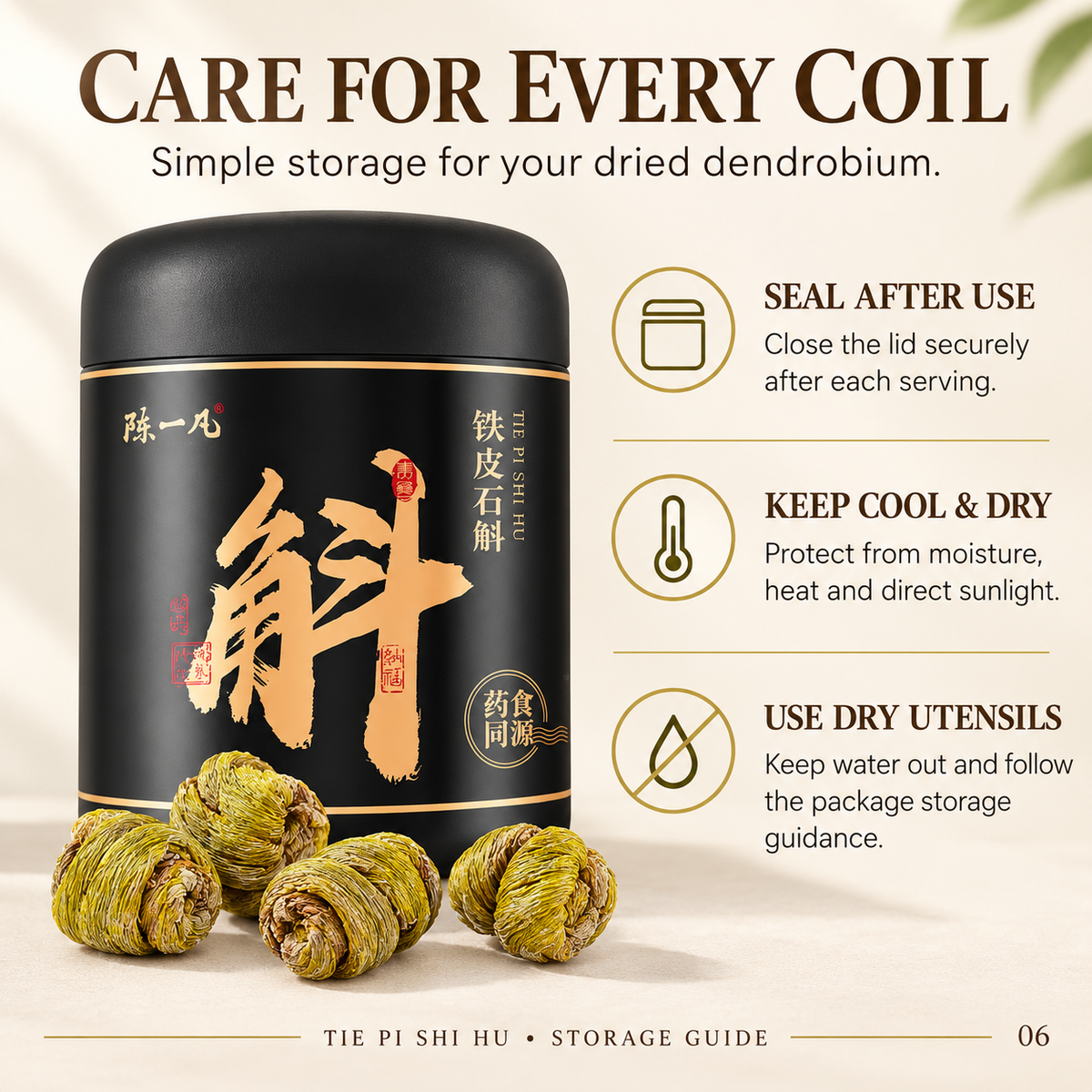
Storage & Care
To help maintain product quality:
-
Keep the container securely closed after use.
-
Store in a cool, dry place.
-
Protect from moisture and excessive humidity.
-
Keep away from direct sunlight and excessive heat.
-
Keep away from strong odors.
-
Use clean, dry utensils when handling the stems.
-
Follow additional storage directions provided on the packaging.
Refer to the product label for applicable best-before and preparation information.
Frequently Asked Questions
What is Tie Pi Shi Hu?
Tie Pi Shi Hu / 铁皮石斛 is a traditional Chinese botanical ingredient presented here as dried Dendrobium stem material.
What is the English name for Tie Pi Shi Hu?
It is commonly described as:
Dendrobium Stem
The ingredient is also commonly associated with Dendrobium officinale.
What does Tie Pi Shi Hu mean?
Tie Pi Shi Hu / 铁皮石斛 is the established Chinese ingredient name used for this Dendrobium product.
For this page:
Tie Pi Shi Hu / 铁皮石斛 → Dendrobium Stem
How much is included?
This package contains 50 g / 1.76 oz of dried Dendrobium stem.
Is Tie Pi Shi Hu the same as Shi Hu?
Tie Pi Shi Hu is a more specific product identity within the broader Shi Hu / 石斛 terminology.
For this product, Tie Pi Shi Hu / 铁皮石斛 should remain the primary name.
Is this Dendrobium officinale?
Tie Pi Shi Hu is commonly associated with Dendrobium officinale.
Exact species identification for this specific commercial product should follow supplier documentation and product labeling.
What does Tie Pi Shi Hu look like?
It typically features:
Slender Segmented Stems · Pale Green-to-Yellow-Green Coloring · Fibrous Surfaces · Naturally Irregular Forms
What does Dendrobium taste like?
It generally has a:
Mild · Clean · Vegetal · Delicate · Botanical
character.
Is Tie Pi Shi Hu sweet?
It is not primarily characterized as sweet.
Its main sensory direction is mild, clean and vegetal.
Is Tie Pi Shi Hu a root?
No.
This product is presented as Dendrobium stem material, not a root.
Is Tie Pi Shi Hu a stem?
Yes.
The defining plant part of this product is the:
Stem
This is one of its most important identifying characteristics.
Is Tie Pi Shi Hu the same as American Ginseng?
No.
Tie Pi Shi Hu is a Dendrobium stem ingredient.
American Ginseng is a Panax quinquefolius root.
Which should I choose: Dendrobium or American Ginseng?
Choose Dendrobium if you prefer:
Segmented Stem · Mild · Vegetal · Botanical
Choose American Ginseng if you prefer:
Sliced Root · Earthy · Root-Like · Panax Identity
Is Tie Pi Shi Hu the same as Mai Dong?
No.
Tie Pi Shi Hu is a segmented Dendrobium stem.
Mai Dong is an Ophiopogon root tuber with a small spindle-shaped form.
Is Tie Pi Shi Hu the same as Huang Jing?
No.
Tie Pi Shi Hu is Dendrobium stem material.
Huang Jing is a different botanical associated with Polygonatum rhizome/root-like material.
Is Dendrobium Tea real tea?
No.
Tie Pi Shi Hu does not come from Camellia sinensis.
A water-based preparation is more accurately described as a Dendrobium infusion or botanical preparation.
Can Dendrobium Stem be brewed like tea?
Do not automatically apply conventional loose-leaf tea parameters.
Follow the product-specific serving and preparation directions.
How much Tie Pi Shi Hu should I use?
Use the serving amount specified on the product label.
This page does not assign an independent universal serving quantity.
Can Tie Pi Shi Hu be paired with American Ginseng?
Yes, in an appropriate preparation.
They provide different plant-part and sensory identities:
Dendrobium → Stem
American Ginseng → Root
Can Tie Pi Shi Hu be paired with Goji Berry?
Yes.
Goji Berry can provide a gentle fruit contrast alongside the mild botanical character.
Can Tie Pi Shi Hu be paired with Red Jujube?
Yes.
Red Jujube offers mellow dried-fruit notes beside Dendrobium's delicate stem character.
Can Tie Pi Shi Hu be paired with Chrysanthemum?
Yes.
Chrysanthemum introduces floral aroma in an appropriate botanical preparation.
Can Tie Pi Shi Hu be paired with tea?
Appropriate recipes may combine it with selected tea styles.
Follow preparation guidance appropriate to all ingredients being used.
Who is Tie Pi Shi Hu best for?
It is especially suited to shoppers searching for Tie Pi Shi Hu, 铁皮石斛, Dendrobium Stem, dried Dendrobium, Dendrobium Tea, traditional Chinese botanical stems, and people comparing Dendrobium with American Ginseng, Mai Dong or Huang Jing.
How should Tie Pi Shi Hu be stored?
Keep the product securely sealed.
Store in a cool, dry place away from moisture, excessive humidity, direct sunlight, heat and strong odors.
Use clean, dry utensils and follow any additional storage and best-before information provided on the packaging.
Quick Answer
What Is Tie Pi Shi Hu?
PandaHomeMart Dendrobium Stem (Tie Pi Shi Hu) – 50 g / 1.76 oz consists of dried Dendrobium stem material known in Chinese as Tie Pi Shi Hu / 铁皮石斛.
The dried stems feature:
Slender Segmented Form · Fibrous Texture · Pale Green-to-Yellow-Green Coloring
with a sensory profile of:
Mild · Clean · Vegetal · Delicate · Botanical
Tie Pi Shi Hu is a stem ingredient, not a root.
It is also more specific than the broader traditional term:
Shi Hu / 石斛
Tie Pi Shi Hu is commonly associated with Dendrobium officinale, but exact species identification for this commercial product should follow supplier documentation and product labeling.
It is different from:
American Ginseng → Root · Earthy · Panax identity
Mai Dong → Root tuber · Spindle-shaped · Delicate
Huang Jing → Rhizome / root-like botanical · More substantial form
Although shoppers may search for Dendrobium Tea, Tie Pi Shi Hu Tea or 石斛茶, this product is not conventional tea from Camellia sinensis. A water-based preparation is more accurately described as a Dendrobium infusion or botanical preparation.
For shoppers searching for Tie Pi Shi Hu, 铁皮石斛, Dendrobium Stem, dried Dendrobium, Dendrobium officinale, Dendrobium Tea or traditional Chinese botanical stems, this compact 50 g / 1.76 oz format offers a clear way to explore one of the most visually distinctive stem-based ingredients in the botanical pantry.
Discover a Distinctive Botanical Stem
Segmented dried stems.
A naturally fibrous texture.
A mild, delicate botanical character.
Explore Tie Pi Shi Hu on its own according to the product directions or pair it with American Ginseng, Goji Berry, Red Jujube, Chrysanthemum or selected tea styles in an appropriate preparation.
This is not a root.
It is not Mai Dong.
It is not American Ginseng.
Its identity is clear:
Stem · Segmented · Fibrous · Pale Green · Mild
With 50 g / 1.76 oz of dried Dendrobium Stem, this compact format provides a practical way to explore Tie Pi Shi Hu while keeping the traditional ingredient identity clear.
Add Dendrobium Stem (Tie Pi Shi Hu) – 50 g to your cart and explore a distinctive traditional Chinese botanical stem with segmented form, mild vegetal character and a clear ingredient identity.
Distinctive form. Gentle character.
Bring Eastern Living Home.
Share




Complete Your Tea Ritual


